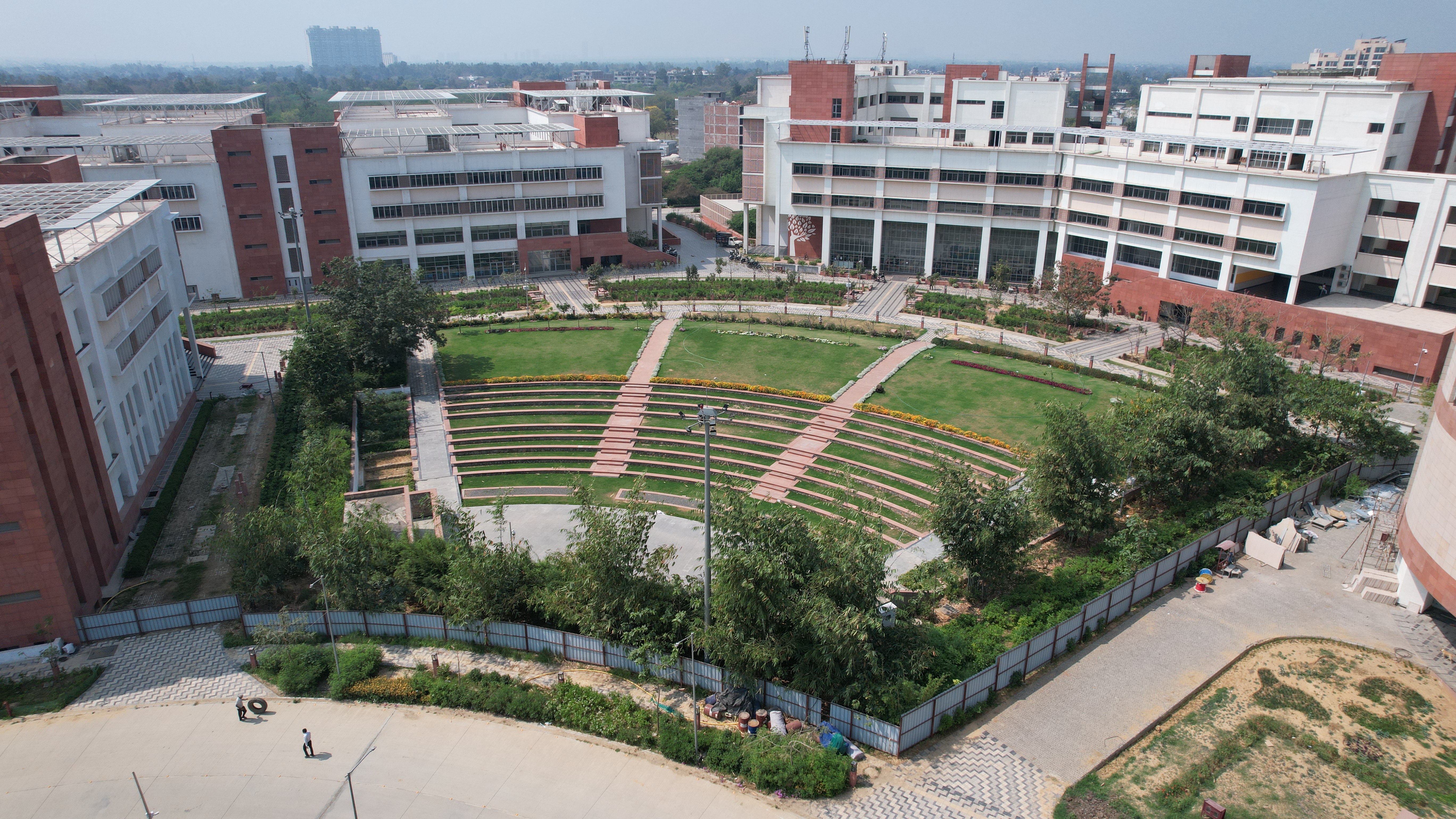
South Asian University's Global MS in Intelligent Transportation Systems and Sustainable Mobility is a practice-oriented postgraduate programme designed for mid-career professionals seeking advanced expertise at the intersection of technology, policy, and transportation infrastructure. Strongly aligned with India's national priorities — particularly the deployment of Multi-Lane Free Flow (MLFF) tolling systems and intelligent mobility platforms — the programme aims to support the reduction of logistics costs from 12–14% to 6–8% of industrial output through data-driven systems. With a deliberate focus on South Asia and the Global South, academic inputs, case studies, and institutional collaborations will progressively draw on expertise from SAARC member countries.
Transportation systems worldwide are undergoing rapid transformation. The programme responds to four converging forces reshaping the sector:
A significant gap exists in postgraduate-level professionals capable of bridging technology, policy, and on-ground implementation. This programme addresses that gap through a hybrid academic–industry model with strong regional relevance.
The programme is multidisciplinary by design, targeting professionals across a range of sectors:
|
Professional Background |
Relevant Domain |
|
Engineering |
Transportation and infrastructure engineering |
|
Government & Policy |
Public policy, regulation, and transport planning |
|
Urban Mobility |
Smart city planning and urban mobility systems |
|
Logistics & Supply Chain |
Freight, supply chain management, and operations |
|
Digital & Telecom |
Data systems, telecom infrastructure, and digital platforms |
Candidates are assessed against the following criteria:
|
Criterion |
Requirement |
|
Academic Qualification |
Bachelor's or Master's degree in a relevant discipline |
|
Professional Experience |
Meaningful experience in a relevant field |
|
Domain Expertise |
Demonstrated expertise and leadership in the applicant's field |
|
Statement of Purpose |
Clear motivation for advanced study in intelligent transportation |
|
Interview |
Interaction with the Admissions and Research Committee |
Academic qualification in the following area:
Multidisciplinary backgrounds are actively encouraged, and rigid discipline filters are deliberately avoided.
A minimum aggregate of 55% marks or equivalent CGPA in the qualifying degree shall ordinarily be required, subject to relaxation for reserved categories as per Government of India and University norms.
Admission Application Link : Apply Here
| Program Description | Particulars | In USD | In INR @ Rs.91 | Remarks / Clarification |
| Global Executive MS Program (2 years or 04 Semesters) | Registration | 20 | 1,820 | One time |
| Admission | 200 | 18,200 | One time | |
| Security Deposit (Refundable) | 200 | 18,200 | 75% of the refund at the time of completion of the course | |
| Tuition | 1500 | 1,36,500 | Per semester | |
| Student Aid Fund | 10 | 910 | Per semester | |
| Industry Liaison Fees (Cross industry connect during and after the program, mentoring, and meeting, among others) | 490 | 44,590 | One time at the time of Admission |
Evaluation follows an Outcome-Based Education (OBE) model with clearly weighted assessment components across all semesters:
|
Assessment Component |
Description |
|
Continuous Assessment |
Assignments, case studies, and presentations (40% weightage) |
|
End Semester Examination |
Formal examination at end of each semester (60% weightage) |
|
Project Evaluations |
Applied industry or policy projects assessed for practical impact |
|
Periodic Progress Reviews |
Structured reviews of academic progress each semester |
|
Innovation Lab |
Prototype development aligned with real-world ITS challenges |
|
Dissertation / Capstone |
Final research output demonstrating original contribution (Semester IV / Last semester) |
Doctoral outputs may include applied research papers, industry-validated solutions, policy or technical frameworks, and presentations at recognized academic or professional forums.
Matters relating to progress monitoring, credit completion, course submission, and final evaluation are governed under the applicable SAU Regulations, ensuring institutional consistency and academic rigour throughout the programme.
The admission process is structured across three stages:
|
Step |
Stage |
Details |
|
1 |
Application |
Submit educational certificates and supporting documents online |
|
2 |
Interview |
Shortlisted candidates appear before a committee of subject-matter experts |
|
3 |
Offer Letter |
Successful candidates receive an official offer letter confirming admission |
© 2025 Copyright. All rights reserved.
Total Visitor: 606,294