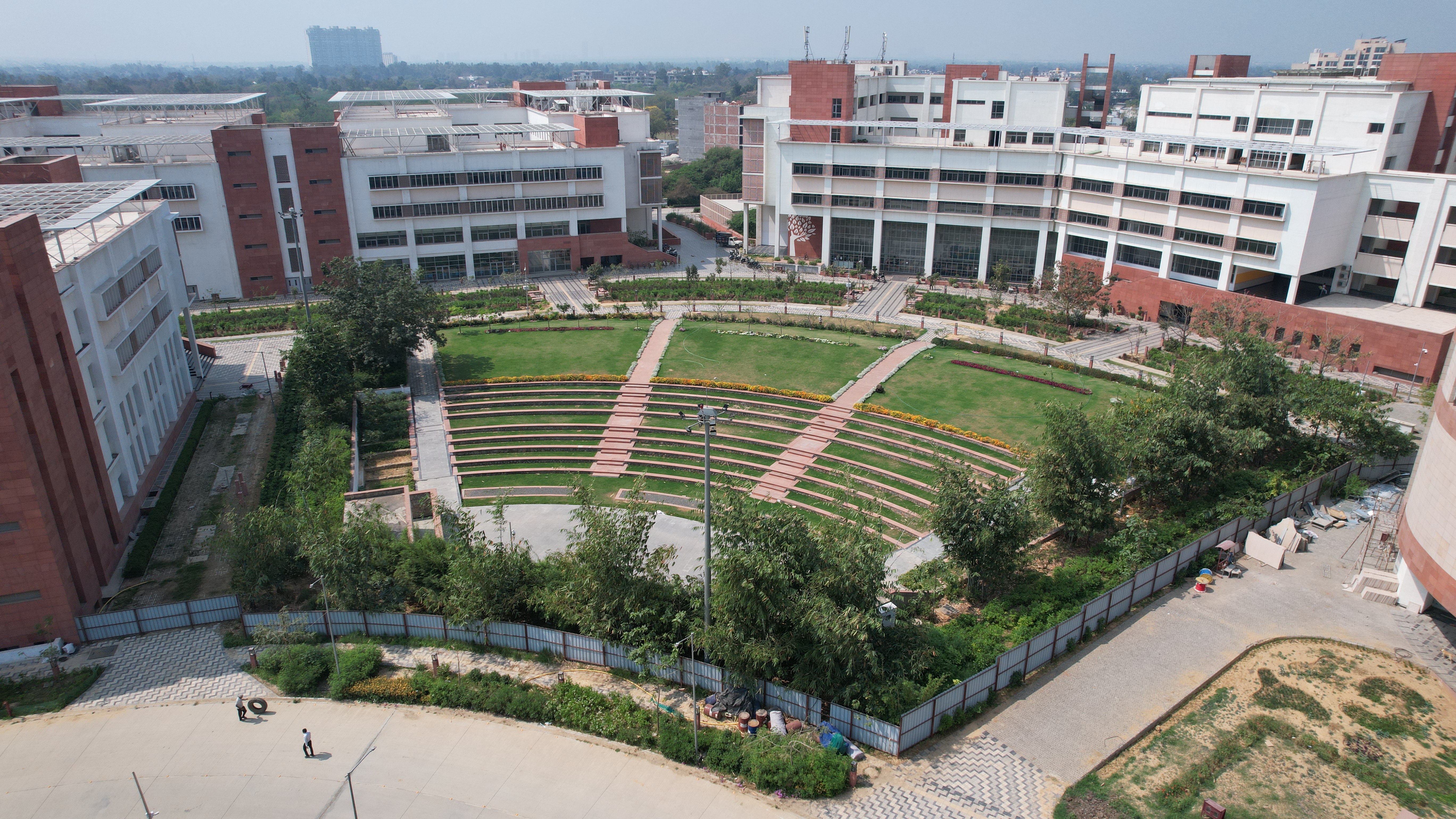
The Department of Computer Science and Engineering was established in the University in 2010. The department offers degree programmes at doctoral, masters and bachelor levels. The two-year MTech (CSE) programme offers an advanced curriculum focusing on research and development in cutting-edge computing fields such as artificial intelligence, machine learning, high-performance computing, cybersecurity, and networking. The programme is designed to foster analytical thinking, problem-solving, and technical expertise through rigorous coursework and project-based learning. Students gain hands-on experience in state-of-the-art labs and work on real-world challenges in collaboration with industry and academia. With a strong research emphasis, the programme prepares graduates for leadership roles in technology, research institutions, and academia, contributing to the evolution of the digital world.
Specialization Options: Students admitted into any of the Masters programmes will be provided the option to follow the general track or to opt to have specialization either in AI & ML or in Advanced Networks & Systems) before the beginning of the first semester
Two-Year Programme
A Candidate must have passed a 4-year B.Tech./B.E./BSc. (Engg.)/BS degree in Computer Science and Engineering or a relevant area* from a recognized institution or an examination recognized by the University as its equivalent with a minimum of 55% marks (or an equivalent grade)
0R
A Candidate must have passed a Master’s degree in Computer Science/ Computer Applications/ Mathematics/ Operational Research/ Statistics/ Electronics/ Information Technology/ Physics from a recognized institution or an examination recognized by the University as its equivalent with a minimum of 55% marks (or an equivalent grade)
*Relevant Areas:
Admission to various Master’s programmes is offered through two modes:
1. SAU Entrance Test Mode:
2. Direct Admission Mode (Without SAU Entrance Test):
For more information – Click Here
|
Total Seats : 30 |
|||
|
India: 15 |
Remaining SAARC Countries |
||
|
SAU Entrance Test: 8 |
Direct Mode: 7 |
SAU Entrance Test: 8 |
Direct Mode: 7 |
Note: Vacant seats in one category will be transferred to another category.
Discrete Mathematics: Propositional and first order logic, Sets, relations, functions, partial orders and lattices, Monoids, Groups, Graphs: connectivity, matching, coloring, Combinatorics: counting, recurrence relations, generating functions.
Linear Algebra: Matrices,determinants,system of linear equations, eigenvalues and eigenvectors, LU decomposition.
Calculus: Limits, continuity and differentiability, Maxima and minima, Mean value theorem, Integration.
Probability and Statistics: Random variables, Uniform, normal, exponential, Poisson and binomial distributions, Mean, median, mode and standard deviation, Conditional probability and Bayes theorem.
Digital Logic: Boolean algebra, Combinational and sequential circuits, Minimization, Number representations and computer arithmetic (fixed and floating point).
Computer Organization and Architecture: Machine instructions and addressing modes, ALU, data‐path and control unit, Instruction pipelining, pipeline hazards, Memory hierarchy: cache, main memory and secondary storage; I/O interface (interrupt and DMA mode).
Programming and Data Structures: Programming in C, Recursion, Arrays, stacks, queues, linked lists, trees, binary search trees, binary heaps, graphs.
Algorithms: Searching, sorting, hashing, Asymptotic worst case time and space complexity, Algorithm design techniques: greedy, dynamic programming and divide‐and‐conquer, Graph traversals, minimum spanning trees, shortest paths.
Theory of Computation: Regular expressions and finite automata, Context-free grammars and push-down automata, Regular and context-free languages, pumping lemma, Turing machines and undecidability.
Operating Systems: System calls, processes, threads, inter‐process communication, concurrency and synchronization, Deadlock, CPU and I/O scheduling, Memory management and virtual memory, File systems.
Databases: ER‐model, Relational model: relational algebra, SQL, Integrity constraints, normal forms, File organization and indexing, Transactions and concurrency control.
Computer Networks: OSI and TCP/IP Protocol Stacks; Basics of packet, circuit and virtual circuit-switching; Data link layer: framing, error detection, Medium Access Control, Ethernet bridging; Routing protocols: shortest path, flooding, distance vector and link state routing; Fragmentation and IP addressing, IPv4, CIDR notation, Basics of IP support protocols (ARP, DHCP, ICMP), Network Address Translation (NAT); Transport layer: flow control and congestion control, UDP, TCP, sockets; Application layer protocols: DNS, SMTP, HTTP, FTP, Email.
For a sample test paper, click here.
© 2025 Copyright. All rights reserved.
Total Visitor: 123,396