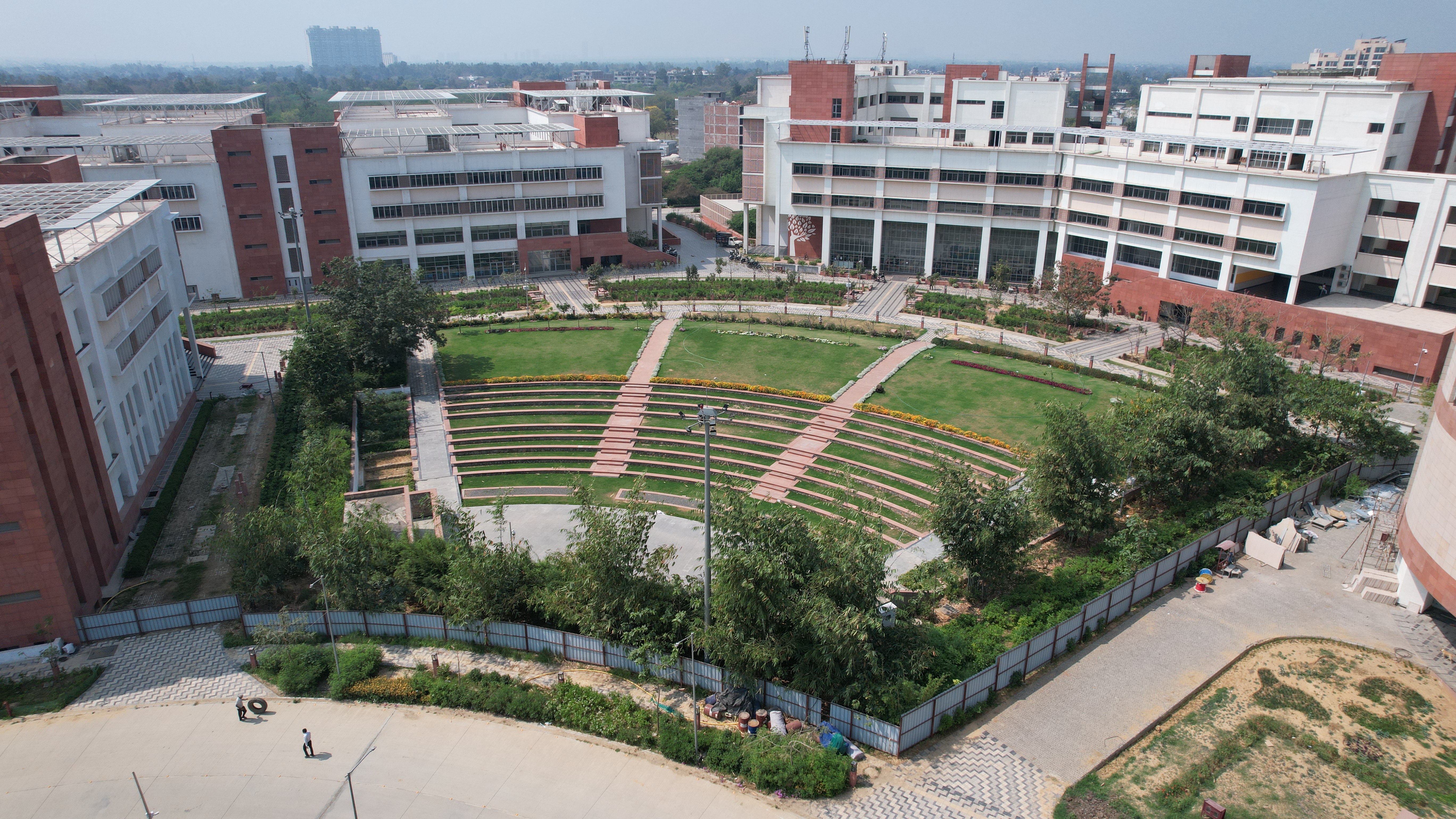
The Department of Computer Science and Engineering was established in the University in 2010. The department offers degree programmes at doctoral, masters and bachelor levels. The MSc programmes in Computer Science offer advanced curricula that bridges core computing concepts with emerging technologies. Designed for students with a strong foundation in computer science, the programme covers key areas such as algorithms, artificial intelligence, machine learning, data science, cybersecurity, and cloud computing. With a blend of theoretical knowledge and hands-on research, students develop critical problem-solving and analytical skills. The programme prepares graduates for careers in research, academia, and industry, equipping them to tackle complex computational challenges and contribute to technological advancements.
Specialization Options: Students admitted into any of the Masters programmes will be provided the option to follow the general track or to opt to have specialization either in AI & ML or in Advanced Networks & Systems) before the beginning of the first semester
One-Year Programme
A candidate must have passed Bachelor's degree in Computer Science or a closely related discipline* with Mathematics as a subject either at the Bachelor’s level or at the 10+2 (12th class) level under 10+2+4 pattern from a recognized institution or an examination recognized by the University as its equivalent with a minimum of 55% marks (or an equivalent grade).
*Indicative List of Closely Related Disciplines:
Computer Science and Engineering/ Computer Engineering/ Computer Applications/ Information Technology
Two-Year Programme
A candidate must have passed a 3 or 4 year Bachelor's degree in Computer Science or a relevant area* with Mathematics as a subject either at the Bachelor’s level or at the 10+2 (12th class) level from a recognized institution or an examination recognized by the University as its equivalent with a minimum of 55% marks (or an equivalent grade).
*Indicative List of Relevant Areas:
• Computer Science and Engineering / Computer Engineering/ Computer Applications/Information Technology
• Any other Science/Engineering areas having at least one-fifth Computer Science courses
Note: In the case where Master's Programme is available in one as well as in two year format, the candidates are advised to choose the programme appropriately as per their eligibility. In case, a candidate has opted for one year programme and later it is found that he/she is not eligible for one year programme but is eligible for two year programme, he/she will be offered two year programme. Moreover, if eligible for both, at the time of admission, the switch between one year and two year programmes is allowed.
Admission to various Master’s programmes is offered through two modes:
1. SAU Entrance Test Mode:
2. Direct Admission Mode (Without SAU Entrance Test):
For more information – Click Here
|
Total Seats : 30 |
|||
|
India: 15 |
Remaining SAARC Countries |
||
|
SAU Entrance Test: 8 |
Direct Mode: 7 |
SAU Entrance Test: 8 |
Direct Mode: 7 |
Note: Vacant seats in one category will be transferred to another category.
Operating System (OS): Overview of OS, functionalities and characteristics of OS, process and process states, threads, CPU scheduling and algorithms, memory management, memory allocation strategies, virtual memory concepts, paging and segmentation.
For a sample test paper, click here.
The Department of Computer Science and Engineering was established in the University in 2010. The department offers degree programs at doctoral, masters and bachelor levels. The M.Sc. programs in Computer Science offer advanced curricula that bridges core computing concepts with emerging technologies. Designed for students with a strong foundation in computer science, the program covers key areas such as algorithms, artificial intelligence, machine learning, data science, cybersecurity, and cloud computing. With a blend of theoretical knowledge and hands-on research, students develop critical problem-solving and analytical skills. The program prepares graduates for careers in research, academia, and industry, equipping them to tackle complex computational challenges and contribute to technological advancements. Both of our MSc programs focus on advanced theoretical and practical knowledge in science comprising coursework, and research projects leading to thesis/dissertation.
Scopes for Specialization: Students admitted into any of the Masters programs will be provided the option to follow the general track or to opt to have specialization either in AI & ML or in Advanced Networks & Systems) before the beginning of the first semester
A candidate must have passed a 3 or 4 year Bachelor's degree in Computer Science or a relevant area* with Mathematics as a subject either at the Bachelor’s level or at the 10+2 (12th class) level from a recognized institution or an examination recognized by the University as its equivalent with a minimum of 55% marks (or an equivalent grade).
*Indicative List of Relevant Areas:
• Computer Science and Engineering / Computer Engineering/ Computer Applications/Information Technology
• Any other Science/Engineering areas having at least one-fifth Computer Science courses
Note: In the case where Master's Programme is available in one as well as in two year format, the candidates are advised to choose the programme appropriately as per their eligibility. In case, a candidate has opted for one year programme and later it is found that he/she is not eligible for one year programme but is eligible for two year programme, he/she will be offered two year programme. Moreover, if eligible for both, at the time of admission, the switch between one year and two year programmes is allowed.
Admission to various Master’s programmes is offered through two modes:
1. SAU Entrance Test Mode:
2. Direct Admission Mode (Without SAU Entrance Test):
For more information – Click Here
|
Total Seats (For 1 Year and 2 Year Program) : 20 |
|||
|
India: 10 |
Remaining SAARC Countries |
||
|
SAU Entrance Test: 5 |
Direct Mode: 5 |
SAU Entrance Test: 5 |
Direct Mode: 5 |
Operating System (OS): Overview of OS, functionalities and characteristics of OS, process and process states, threads, CPU scheduling and algorithms, memory management, memory allocation strategies, virtual memory concepts, paging and segmentation.
For a sample test paper, click here.
© 2025 Copyright. All rights reserved.
Total Visitor: 123,403