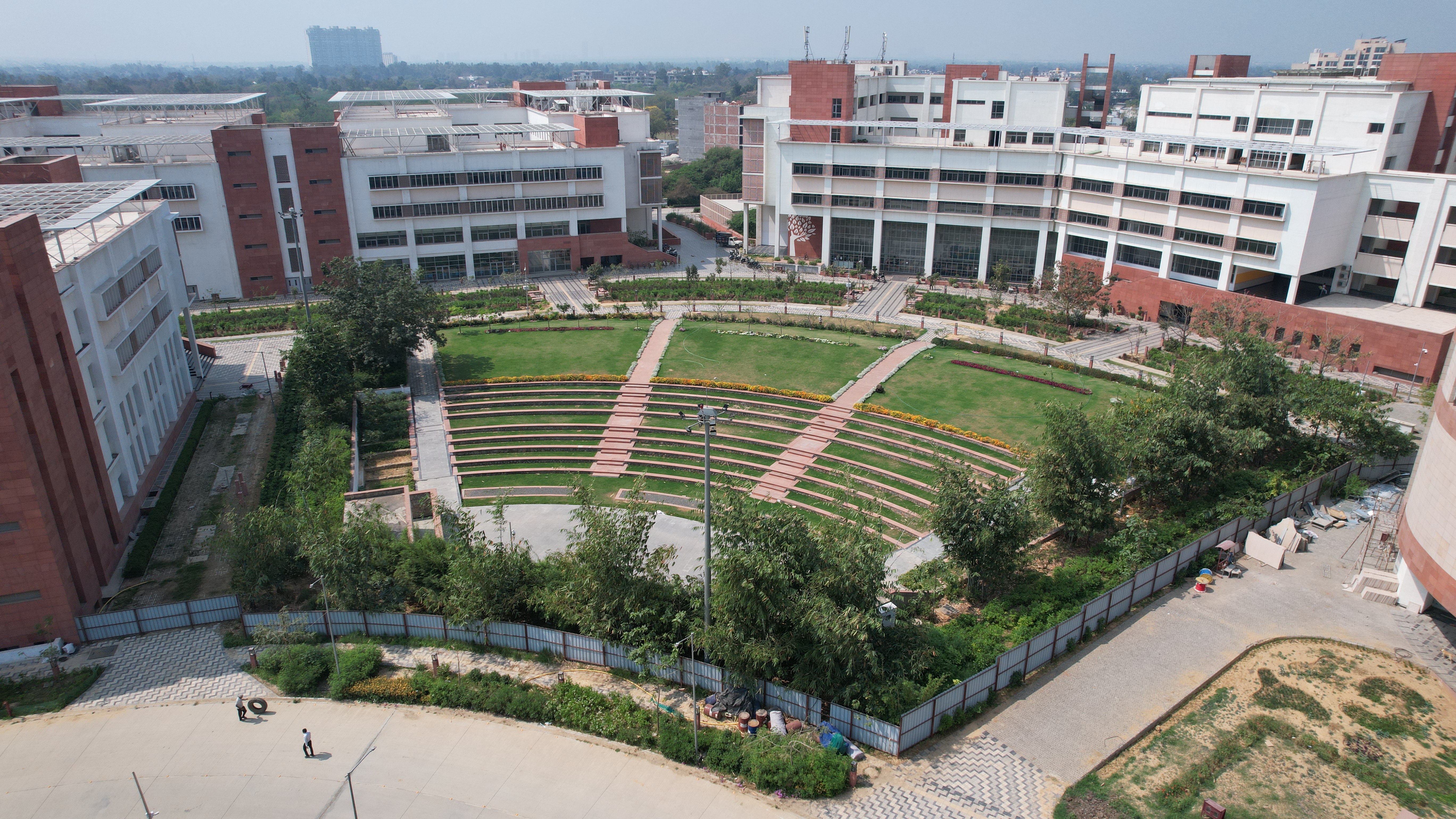
Integrated MTech Computer Science & Engineering
The Department of Computer Science and Engineering was established in the University in 2010. The department offers degree programmes at doctoral, masters and bachelor levels. The Integrated MTech programme is a 3-Year programme. The first part focuses on MSc coursework (theoretical and scientific concepts) and the second part transitions into MTech (technical, engineering, and applied sciences) which often includes research, projects, and sometimes industry internships. It has more job opportunities in technical and applied research roles.
Specialization Options: Students admitted into any of the Masters programmes will be provided the option to follow the general track or to opt to have specialization either in AI & ML or in Advanced Networks & Systems) before the beginning of the first semester
Eligibility
Three-Year Programme
A candidate must have passed a Bachelor's degree under 10+2+3 or 10+2+4 pattern in Computer Science or a relevant area* with Mathematics as a subject either at the Bachelor’s level or at the 10+2 (12th class) from a recognized institution or an examination recognized by the University as its equivalent with a minimum of 55% marks (or an equivalent grade).
*Indicative List of Relevant Areas:
• Computer Science and Engineering / Computer Engineering / Computer Applications / Information Technology
• Any other Science / Engineering areas having at least one-fifth Computer Science courses
Modes of Admission
Admission to various Master’s programmes is offered through two modes:
1. SAU Entrance Test Mode:
- For Indian Candidates: Center-based online tests conducted by the University.
- For other SAARC Candidates (excluding India): Proctored online tests on stipulated dates.
2. Direct Admission Mode (Without SAU Entrance Test):
- In India: Based on scores from national-level tests (Like JEE/CUET/NEET/CAT/CLAT/NET/GATE etc).
- In Other SAARC Countries: Based on national-level test scores or qualifying examination results from recognized institutions.
- For Non-SAARC Candidates: Based on scores obtained in their qualifying examination.
For more information – Click Here
Seat Matrix
|
Total Seats : 30
|
|
India: 15
|
Remaining SAARC Countries
+ Other Countries: 15
|
|
SAU Entrance Test: 8
|
Direct Mode: 7
|
SAU Entrance Test: 8
|
Direct Mode: 7
|
Note: Vacant seats in one category will be transferred to another category.
- The duration of the Entrance Test will be 2 hours.
- The question paper will consist of 70 multiple choice questions.
- There will be no negative marking.
- Calculators will not be allowed. However, Log Tables may be used.
Syllabus for Entrance Test
- Set Theory and Algebra: Sets, Relations, Functions, Groups, Partial Orders, Lattice, Boolean Algebra.
- Combinatorics: Permutations, Combinations, Counting, Summation, Binomial Theorem, Exponential Series.
- Matrix: Basic Concepts, Types of Matrices, Determinants, Transpose, Inverse and Rank of a Matrix, Matrix Algebra, Systems of Linear Equations.
- Calculus: Limit, Continuity and Differentiability, Mean Value Theorems, Theorems of Integral Calculus, Evaluation of Definite and Improper Integrals, Partial Derivatives, Total Derivatives, Maxima and Minima.
- Ordinary Differential Equations: First Order First Degree Equations, Variable Separable Method, Homogeneous Equations, Exact Equations, Integrating Factors, Linear Equations.
- Vector Analysis: Addition, Subtraction, Dot Product and Cross Products of Vectors.
- Programming in C: Elements of C, Identifiers, Data Types, Control Structures, Array, Structure, Union, Strings, Pointers, Functions, Parameter Passing to Functions, Recursion, File Handling.
- Data Structures & Algorithms: Elementary Concepts of List, Stack, Queue, Tree and Graph, Space and Time Complexity Analysis, Sorting Techniques: Bubble Sort, Insertion Sort, Selection Sort, Merge Sort, Quick Sort, etc., Searching Techniques: Linear and Binary Search.
- Database Management System: Basic Concepts, Attributes, Entity and Relationships, ER Diagram, Database Decomposition and Normalization, Database Constraints, Relational Algebra, SQL.
- Digital Logic and Computer Architecture: Number System, Data Representation, Compliments, Computer Arithmetic, Logic Gates, Combinational and Sequential Circuits, Computer Organization, Instruction Formats and Addressing Modes, Memory Organization and I/O Interfaces.
- Computer Networks: Introduction to computer networks, transmission media, transmission modes, network types: LAN, MAN, and WAN, network topologies, basic concept of MAC and IP Address, reference models: OSI & TCP/IP.
- Operating System (OS): Overview of OS, functionalities and characteristics of OS, process and process states, threads, CPU scheduling and algorithms, memory management, memory allocation strategies, virtual memory concepts, paging and segmentation.
For a sample test paper, click here.