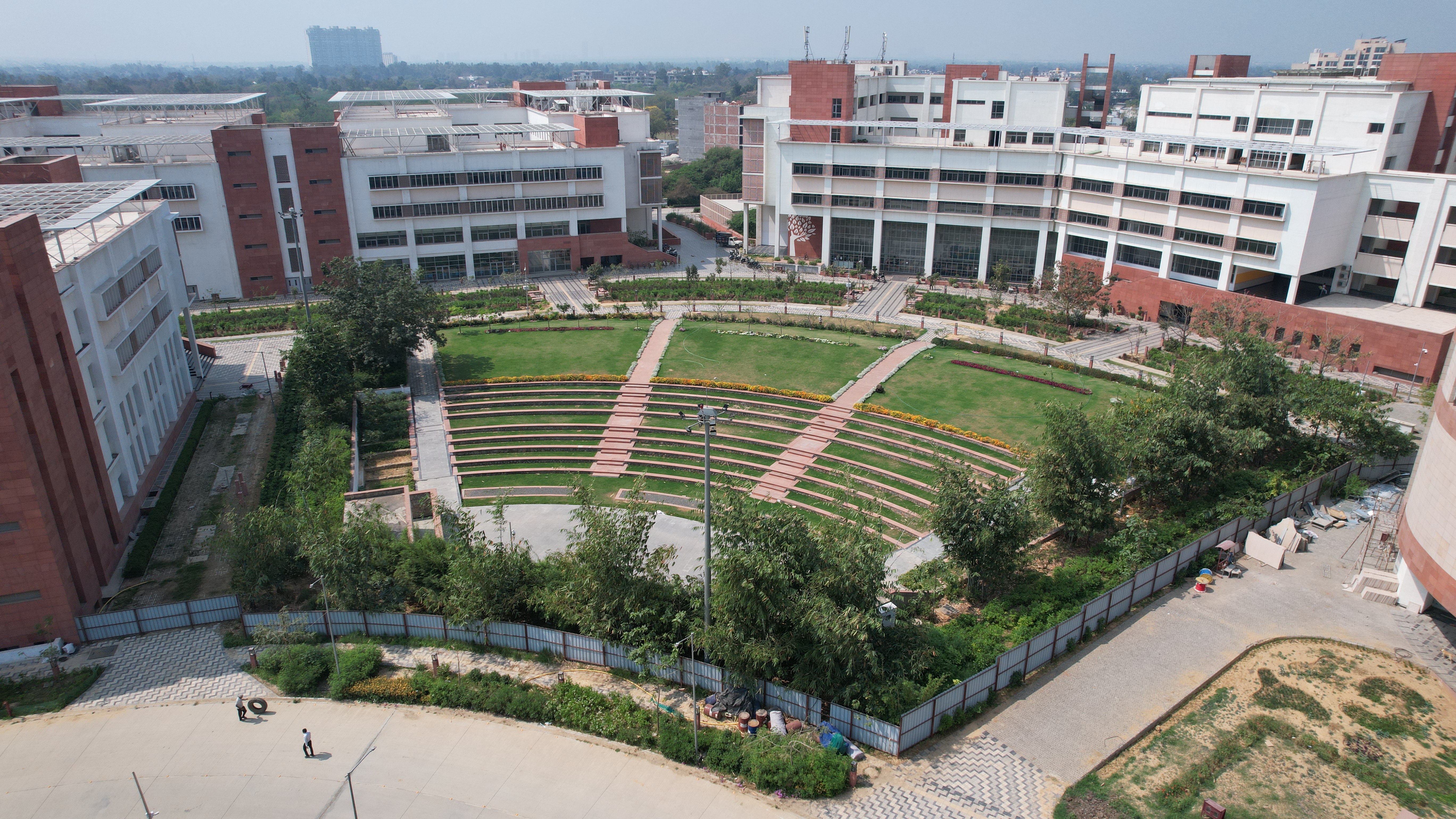
Chemical Sciences department offers a dynamic and research-intensive PhD program engaging with diverse range of cutting-edge scientific opportunities. Scholars can explore advanced topics such as synthetic organic chemistry, computational chemistry, designing of nanoparticles and nanoclusters, Quantum and its application in chemistry, Molecular docking, Asymmetric synthesis, Spectroscopic analysis, Fluorine Chemistry etc. With a strong emphasis on innovation and development, our department provides an ideal environment for ground breaking research and academic excellence in Chemistry.
Candidates must have completed at least 17 years of formal education, which includes 12 years of regular schooling followed by either a 3+2 or 4+1 year Bachelor’s and Master’s degree program in any branch of Chemical Sciences, such as MSc Chemistry, M.Sc. Applied Chemistry and M.Sc. Analytical Chemistry with any specialization. Alternatively, candidates may hold an MS degree from a government-recognized institution in any SAARC country. A minimum of 55% marks or an equivalent grade is required in these qualifications. Candidates with 4-year Bachelor degree in the subject are also eligible for admission to PhD programme provided they have secured a minimum of 80% marks or equivalent grade.
Admission to various PhD programmes is offered through two modes:
1. SAU Entrance Test Mode:
2. Direct Admission Mode (Without SAU Entrance Test):
Under the Entrance Test mode, the admission procedure for the PhD programme consists of an Entrance Test followed by an interview.
Under the Direct and Executive modes, candidates will be shortlisted and called directly for the interview.
For further details, please refer to the General Guidelines for the PhD Programmes.
The number of scholarship seats through the Entrance Test mode is 1, while the number of seats through the Direct & Executive mode shall be based on availability.
Inorganic Chemistry: Chemical periodicity and the structure and bonding in homo- and heteronuclear molecules. Concepts of acids and bases. Main group elements and their industrial importance. Transition elements and coordination compounds: structure, bonding theories, spectral and magnetic properties, reaction mechanisms. Organometallic compounds: synthesis, bonding and structure, and reactivity. Organometallics in homogeneous catalysis. Bioinorganic chemistry: photosystems, porphyrins, electron-transfer reactions; nitrogen fixation, metal complexes in medicine. Nuclear chemistry: nuclear reactions, fission and fusion, radio-analytical techniques and activation analysis.
Physical Chemistry: Basic principles of quantum mechanics: postulates; operator algebra; exactly solvable systems: particle-in-a-box, harmonic oscillator and the hydrogen atom, including shapes of atomic orbitals; orbital and spin angular moments. Atomic structure and spectroscopy; term symbols; many-electron systems and anti-symmetry principle. Chemical bonding in diatomics; elementary concepts of MO and VB theories; Huckel theory for conjugated π-electron systems. Molecular spectroscopy: rotational and vibrational spectra of diatomic molecules; electronic spectra; IR and Raman activities – selection rules; basic principles of magnetic resonance. Chemical thermodynamics: laws, state and path functions and their applications; thermodynamic description of various types of processes; Maxwell’s relations; spontaneity and equilibria; temperature and pressure dependence of thermodynamic quantities; Le Chatelier principle; elementary description of phase transitions; phase equilibria and phase rule; thermodynamics of ideal and non-ideal gases, and solutions.
Organic Chemistry: IUPAC nomenclature of organic molecules including regio- and stereoisomers. Principles of stereochemistry: configurational and conformational isomerism in acyclic and cyclic compounds. Aromaticity: benzenoid and non-benzenoid compounds – generation and reactions. Organic reactive intermediates: generation, stability and reactivity of carbocations, carbanions, free radicals, carbenes, benzynes and nitrenes. Organic reaction mechanisms involving addition, elimination and substitution reactions with electrophilic, nucleophilic or radical species. Organic transformations and reagents: functional group interconversion including oxidations and reductions; common catalysts and reagents (organic, inorganic, organometallic and enzymatic). Pericyclic reactions – electrocyclization, cycloaddition, sigmatropic rearrangements and other related concerted reactions. Principles and applications of photochemical reactions in organic chemistry. Synthesis and reactivity of common heterocyclic compounds containing one or two heteroatoms (O, N, S). Structure determination of organic compounds by IR, UV-Vis, ¹H & ¹³C NMR and mass spectroscopic techniques. Chemistry in nanoscience and technology and green chemistry.
© 2025 Copyright. All rights reserved.
Total Visitor: 123,428